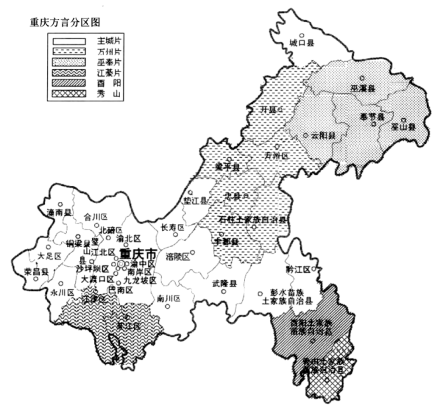
About Chongqing dialect:Chongqing dialect(Chinese: 重庆话; pinyin:Chóngqìnghuà; Sichuanese pinyin: Cen2yu2, ) is the most widely used branch of Southwestern Mandarin, with about 90 million speakers. It is named after Chengdu, the capital city of Sichuan, and Chongqing, which was split from Sichuan in 1997. It is spoken mainly in northern and eastern Sichuan, the northeastern part of the Chengdu plain, several cities or counties in southwestern Sichuan (Panzhihua攀枝花, Dechang德昌, Yanyuan盐源, Huili会理,and Ningnan宁南), southern Shaanxi陕西 and western Hubei湖北.
1.Hello.
你好。
ni hao。
2.Have you eaten?
你吃饭了没得?
ni ci fan le mei de?
3.What time is it now?
现在几点了?
xian zai ji dian le?
4.What is your name?
你叫啥子名字?
ni jiao sha zi ming zi?
5.My name is David.
我叫大卫。
wo jiao da wei。
6.Thank you.
谢谢你。
xie xie ni
7.Your welcome.
不用谢。
bu yong xie。
8.Where is the bathroom?
洗手间在哪里?
xi shou jian zai na li?
9.Nice to meet you。
很高兴见到你。
hen gao xing jian dao ni。
10.Turn left and then turn right.
先左转然后右转。
xian zuo zuan ran hou you zuan。
11.What would you like to drink?
你想喝点啥子?
ni xiang he dian sa zi?
12.I want like a cup of coffee.
我想要一杯咖啡。
wo xiang yao yi bei ka fei。
13.He is my older brother.
他是我大哥。
ta si wo da ge。
14.She is my younger sister.
她是我小妹。
ta si wo xiao mei。
15.They are my friends.
他们是我的朋友。
ta men si wo de peng you。
16.Today, we are going to see a movie.
今天我们打算去看电影。
jin tian wo men da suan qu kan dian ying。
17.Yesterday, I went to the library to study English.
我的波棱盖被马路牙子卡秃了皮了 means My knee was bruise by thr roadside😄 这个人得儿呵的=This man is silly. 来且儿了=Someone is visiting. 家巧儿=Sparrow 轱辘=tyre 麻溜地=Hurry up. If someone does something stupid, you can tell him,你咋得儿呵的呢?= Why are you so stupid? Don’t worry, it’s not a rude word. 1、玻灵盖儿:膝盖 2、埋汰:脏,不讲卫生 3、麻溜儿的:快一点儿做某事 4、贼:特别,很的意思,例如贼好吃,就是特别好吃的意思。 5、界彼儿:邻居,比如我家界彼儿,就是我家邻居的意思。 6、咋整:怎么办。比如这可咋整?就是这可怎么办的意思。 7、铁子:好朋友 8、卡睡:困了。我卡睡了,就是我困了。 9、妈另:蜻蜓。 10、家巧儿:麻雀!例句:老天爷饿不死瞎家巧儿! With Voice
My friend said this, but I didn’t quite understand the meaning: 昨天另一群有個女生向我表白兩次。我的媽呀😂😂 Based on the provided text in Chinese, your friend is saying that yesterday, another group of people (possibly friends or acquaintances) had a girl who confessed her feelings to him twice. In Chinese, the phrase “我的媽呀” (wǒ de mā ya) is an interjection…